AI and PseudoPoetry
The output, below, extracted from Gemini, was in response to the following prompt:
‘Write a poem in algebraic symbols’
As can be seen from a (much) earlier post, I have been, and continue to be, intrigued. By things that mimic poetry, that want to be poetry, things that attempt to speak, but that are somehow ‘screened’, and which fail to breakthrough.There is a pathos in the attempt.
After a long break in writing such things, whatever they are, I thought to make fresh attempts. Maybe I could utilise other non-natural languages to do so, and push a voice through them? Technical languages such as mathematics, algebraic symbols, logic operatives, even typographic units, emojis, symbols, and, of course, genetic code and gene related terminology. But I am an idiot with regard to the technical aspects of all the sciences. And just out of curiosity, and perhaps for some collaborative thinking, I entered the prompt, already given above, into Gemini. The output is below.
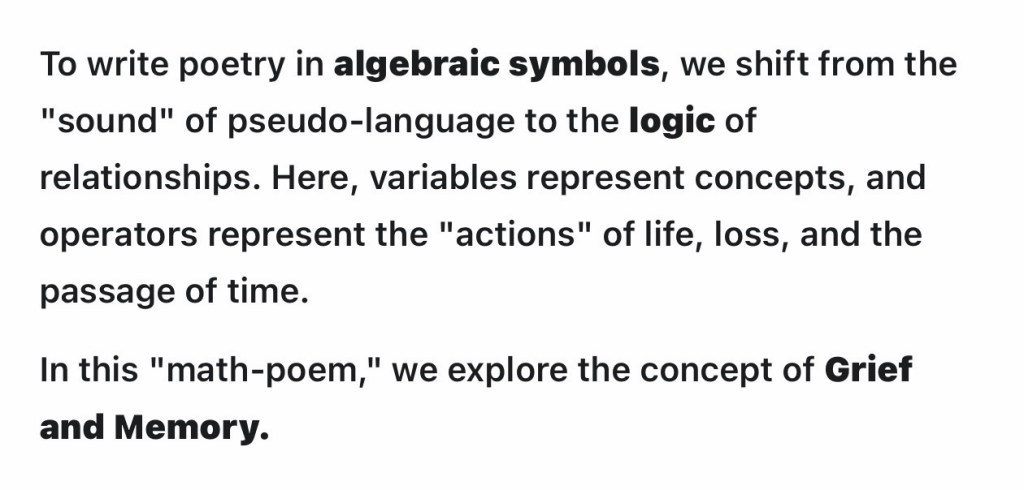
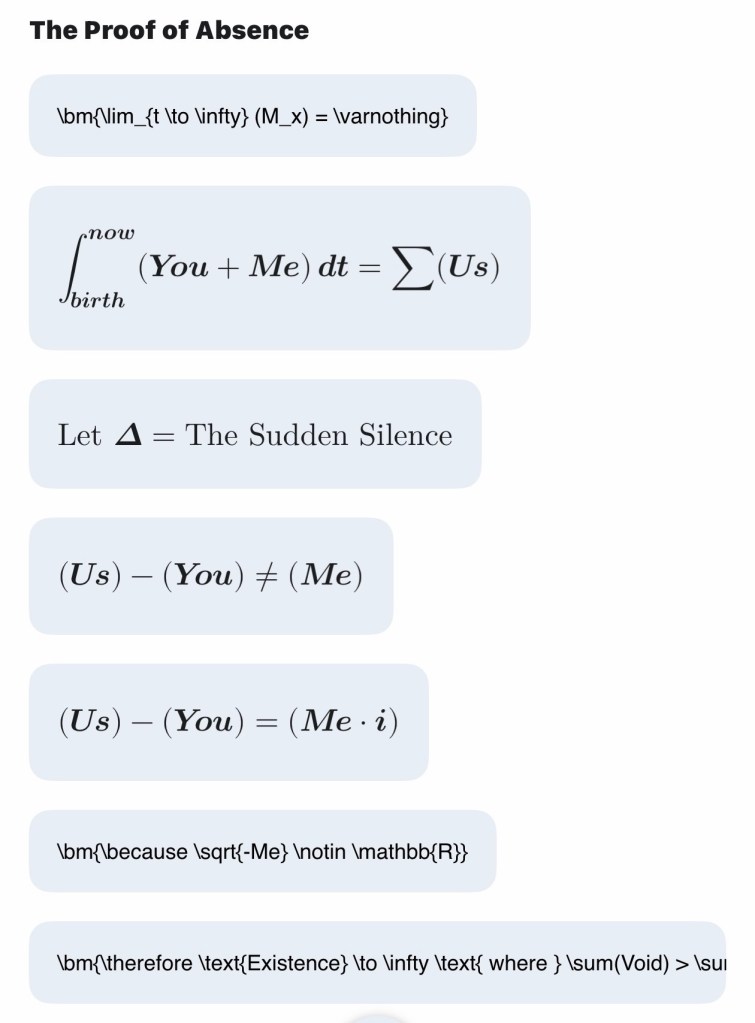
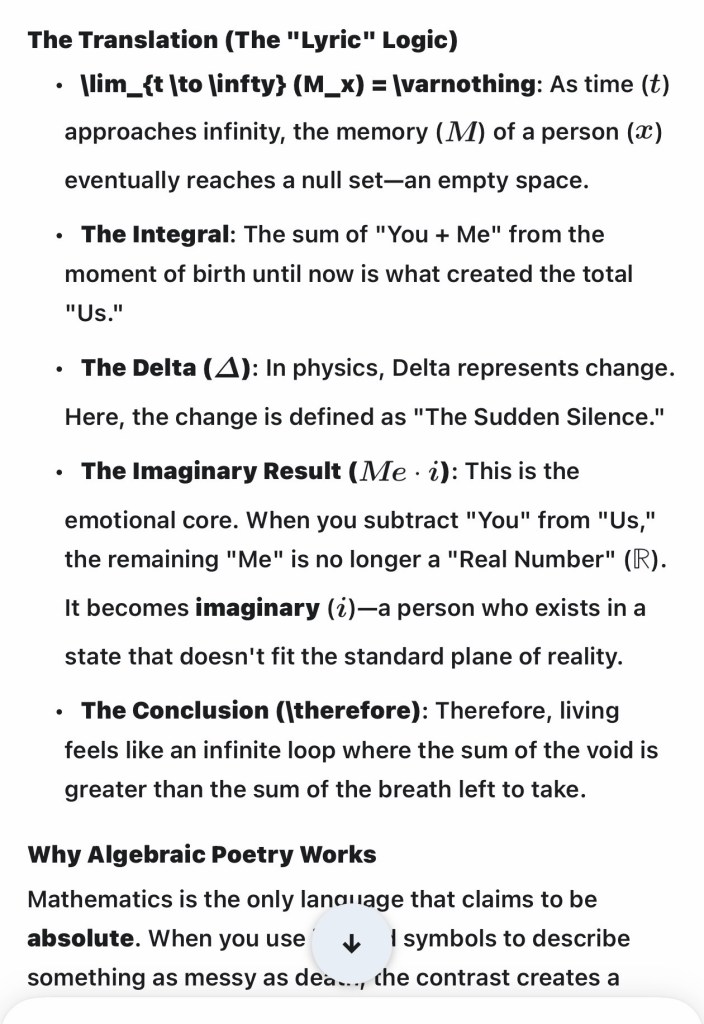
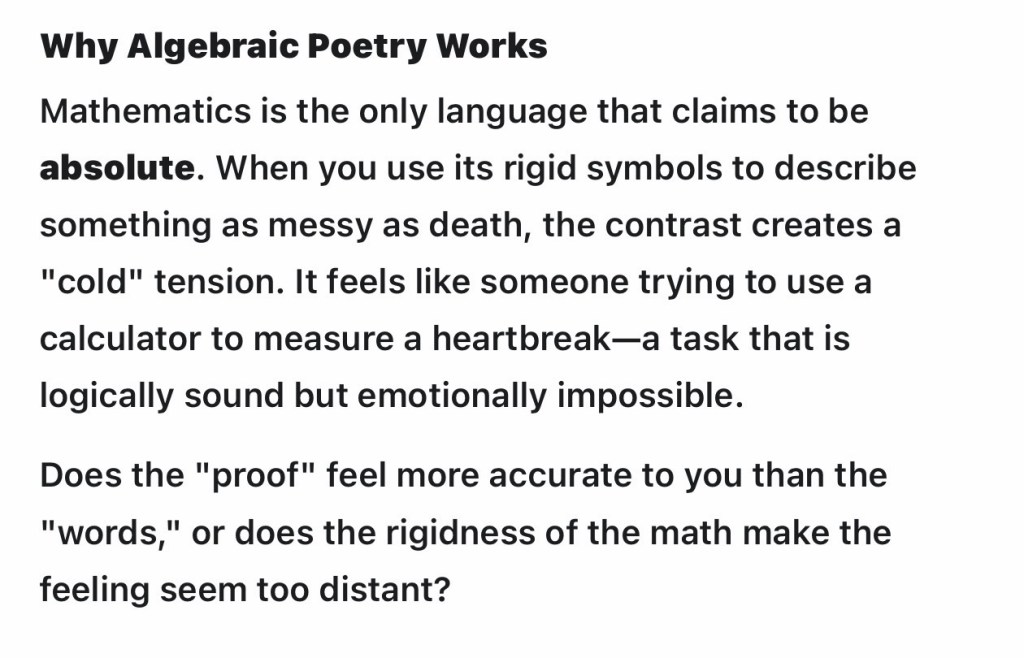
Now, what to say about this? To be honest, my first response was surprise. I read it and thought, could I do better? No. Gemini’s use of algebra went much deeper than simply mimicking the English language. It actually uses the internal rules of information processing within algebra to write a poem that could be read according to those rules. Granted, this is something different from the original grounds of my fascination with pseudo texts, but it is thought provoking in its own right.
The question arises: will AI be capable, in the near or even distant future, of writing poem? Not poetry. Poetry is nothing. The poem is the thing, ontologically. Will AI get there?
Is it there now?
I don’t know. It may depend on your definition of a poem. Or partly on what your definition may contain.
If you think a poem is simply an output of language, part of a game, the product of the application of rules from within the infinite belly of language, then yes. AI is there already, and will only up its game.
It mastered Chess. It mastered Go.
If you see the poem as something that is voiced, something that is modulated by lived human experience, an ecce homo thing (further description temporarily eludes me) then no.
Detailed contact with reality, the world, being in the world (and glimpsing its beyond) is core.
The voice is core.
The issues I have with poetry being taught in universities as a creative writing qualification, with its tendencies to push poetry as a semiotic game played within an academic tradition that abstracts content into itself, are taken by AI to their technical conclusion.
Academic poetry has always operated as an LLM. AI has fed on the same texts, absorbed all the relevant data, and having graduated, can now sit in its bedroom and write poetry.
But not a poem.
I hope.
 FruitFly