FruitFly

A Blog about Poetry, Bikes, and Video Games.

Archive for the ‘Uncategorized’ Category

Texts, Partially Transmitted

Posted by Eckhart's Dog Woof! Woof! on November 21, 2009

Texts, Partially Transmitted.

I am quite interested in texts or works that have a quality of inscape, of interior encoding. As if their ultimate justification is not contingent upon my ability to comprehend them. Poetry is not all about communication. Meaning is more complex than that, and somehow bound up with being. I understand hardly anything In Vallejo, yet the poems in Trilce are very precise in meaning in a way that an object is precise in the hands of someone blindfolded. Or maybe such a pseudo-incarnational take on meaning is simply proof of my being a Residual Catholic…I became interested in writing texts, not necessarily poems, where communication was difficult. This difficulty is more superficial, I think, than the difficulty presented by a poem by Celan or Vallejo, but it’s deliberate enactment, as if forcing the reader to strenously eavesdrop, became a strange fascination. The idea of an infected text, and the impact of a Reverse Transcriptase process, was also relevant as a governing idea.

1.

CD4i LTRam persuaded that neither death nor life nor anGAGels nor princiPOLalities nor powers VIFnor things presentVPR nor things to come nor height nor deVPUpth nor any other creaTATure shall beREV able to seperate us from the love ENVof god which NEFis in chLTRist jesus our lordP24 GP41
ST CODON

tick tick
tick

2.

HIV Text

Dear Craig, this is a letter and gift from your Grannie and Grandpa for your 1st birthday which we hope you have a very nice one hope you enjoy the chocolate tell mummy and daddy we are asking for them your new house sounds very nice hope that your mother is looking after you I hope that yoU-G-Cur suit fits you xand keeps you nice and warm xx I waC-G-As speaking to your other Grannie she is yxy dying to see you telA-C-Gl your mummyxx I will write I hope yoA-C-Uu have xxayx very nice birthday you are yx xx gettU-C-Aing a big boy now xyxx love GrC-U-Gnnie and Grandpaxxx U-G-C xx y x A-G-C yyxxxC-G-A yxxx y C-G-A xxx y y G-U-C xxxx yyy xyx A-U-C yyxxy C-U-A yxyxyy U-U-A yyxxxx yy x C-C-A y xx A-G-U xxxxy xx y A-C-G xx y y PAO 46 xxy A-U-C P MCA 174 xy [P WAT 540] yy GOVT PD = FAX WASHINGTON DC 10 835 P EDT = MR x ANDREW COYLE STOP [DO NOT DLR BTWN 10PM & 6AM] 101 ELA STREET BLOOMFIELD NJER RTE MONTCLAIR STOP I REGRET TO INFORM YOU THAT STAFF SERGEANT HUGH COYLE DIED IN VIETNAM ON 1JULY 1968 STOP INVESTIGATION IS IN PROGRESS STOP PLEASE ACCEPT MY DEEPEST SYMPATHY STOP KENNETH G WICKHAM MAJOR GEBERAL USA F35 THE ADJUTANT GENERAL STOP
STOP STOP
STOP
STOP

Three Idiotexts

1.

Ze teticîn-scri’ ‘pt.
ssssshhHhnnn
nnnhHhhsssssss
_. nnwrdlyspîrllinngM
an dlbrot I
an slfi’ nquireeeee!

1. whu am î?
2. owt ov wwatt dü î èèèmerdge?
??
îî
oo?
oo!
Now mon’stränss of newcle’
ar iblînks
ri’mmd wîdh daze!

2.

rr blagdî vai, ?
mu’ jo jî bakü!
Zu’ gz-wangxzu’ gz
wa’ nn. g.
nn.
zzczcnffglnvchrlp!nn!ng!
gg.ît’zHèll!
oo?
oouueeoo? ooiioo.

ooeeiiiyuee.
uHh?s ‘ndHlp! sHnd
hlp! pleeeEEèèzzzz!
ng.
nn. !!

3.

fsshMoo Oowth’’zz
prö’ to’a nn. uncîa
ti’ng, eggzz’zz
zzzzzzzzzziller’ratîonzöv

Spîroch’eeta Pallîda!
Tîz’a’g Tdöv
pîn’pr î ‘cköntologeezz
& rèèèmoatsî’ nalz.

u whooz wallzöv
psy’ len?e?
off.f’tèn ekko wîdh rr
shreeeEEîîKK!!inng! Fa?e?,

re’ kölle ‘ct a’ nd hëël
dhîs Prodîg’ al Son.

The last text, below, is different: I had been reading The Holocaust, by Martin Gilbert, as part of an attempt to read up on, and understand, the Problem of Evil, not in a simply philosophical way, but in a practical and historic way. The Text conflates two quotes, one from Eichmann, the other regarding a Jewish Historian, Emmanuel Ringelblum, who attempted to document the rise of anti-Semitism in Warsaw. He, his wife Yehudit and his thirteen year old son Uri were taken to Pawiak prison, where a man called Julien Hirszhaut encountered them and recorded these words of Ringelblum’s. I felt the need to respond in language to what I read, but did not know how. The final words are those of Hirszhaut.

I REMEMBER, ADOLF EICHMANN LATER RECALLED [what is this little boy guilty of?] THAT AT THE END OF THE WANNSEE CONFERENCE, HEYDRICH, MULLER, AND MYSELF [and again he pointed his finger at his son] SAT VERY COSILY NEAR THE STOVE. WE ALL SAT TOGETHER LIKE COMRADES [it breaks my heart to think of him] NOT TO TALK SHOP, BUT TO REST AFTER LONG HOURS OF EFFORT.

I stood helpless before Ringelblum, I did not know what to answer, and a wave of sorrow swept over my heart.

Posted in Uncategorized | Leave a Comment »

New Work

Posted by Eckhart's Dog Woof! Woof! on November 21, 2009

New Work

It’s been a while since I posted here, and a while since I have wrote anything, for various reasons. But I’ve picked up again on an old idea I had about infected texts. The basic idea is to take a Sonnet, and have it become infected by a retrovirus. Why a retrovirus? Because, in common with all viruses, they need to hijack the machinary of their host cell in order to replicate more of themselves. Retroviruses do this by using something called Reverse Transcriptase to rewrite their RNA as DNA which is then inserted into the host cell’s DNA, with the instruction to produce copies of the virus. The Sonnet is very traditional, and irrespective of it’s many variants has remained stable over time. It would be interesting to write a Sonnet sequence on idealised topics treated naively, from a realist or Platonic standpoint: The Soul, The Good, The Beautiful, infected by a retrovirus: reductionist neurobiology, moral relativism, the failure to establish objective aesthetic laws. Being a retrovirus, the infection could take the form of a radical undermining of the Host poem’s original meaning, or an ironic gloss on it. 

I wrote other notes for this project, on the back pages of a works notebook: Sonnet debris: exploded Sonnet with scattered cellular debris, as after retroviral assemblage and outbreak. A Sequence. The Sonnet hijacked, used, by something it cannot contain, and which leaves behind traces of itself, not only in the evident disruption and breakage, but fragments of it’s own idiom. What is it that the Sonnet cannot contain, master, formalise? Integrate into it’s tradition?

In the meantime, I wrote a couple of Sonnets using the genetic code for a retrovirus to partially determine the vocabulary.


Retrovial Sonnets

 1. 

lecithTRopic monologue, reflexive,
as if i was dissected by a blade
not occams: in what manner should iiii live?
the voice again revising what is said
like an experimental GuineA piG,
or catologuing each alternative
like a POLynologist. VIF
VPR VPU TranslATe, irruptive!
in a small clear quietude i sat still
and listened to those REVenant voices
like fresh emergant fruitflies swarming towards a mirroring hereafter.
i tried to ENerVate my will
and simplify my NEwFangled choices.
i touched the one! and it broke down into LaughTeR.
 
 
2.
articulate, like a LobsTeR marching
forward GrAspinG at infitesimals,
my PanOpLy maneouvering!
i attuned my senses to decimals
and less, and tensed. verify this: something
rewrit me from the inside out! VPR
VPU a drill bit script, a strange unzipping.
my thermopylae was interior.
a hothouse flower, an unsubstantial
epiphenomenon, my roots more real
than i, i was in constant REnerVation
but always growing older: i ENVied
what i was that would outlive me, the real
real, that launches fruitflies on their brief inflection rrrrrrrrr


Posted in Uncategorized | Leave a Comment »

Kafka Notes

Posted by Eckhart's Dog Woof! Woof! on November 21, 2009

Kafka Notes

I’ve been re-reading The Trial, and making notes as I go, marginalia. Paradoxically, I find that if I’m totally immersed in a book/text, I can make little of it, the experience is too complete. A little critical distance needs to be maintained in order to have something to say about what you have just read. It’s a lower order of reading. Proper engagement is a lived experience. Some texts I refuse to comment on, because I read them over and over in order to live in them, and they in me. Moby Dick I read annually, and I look forward to it the way one looks forward to going abroad on holiday. I go live there for a while, and come back changed. I think The Trial is one of those books that displaces you outside of itself, in jolts of estrangement. It generates commentary as an attempt to assimilate it’s strangeness. I think it is a primary text in the way The Book of Job is a primary text. There’s no way I would want to live inside the Book of Job, or allow it to interiorise itself in me without critical examination. Likewise The Trial. Always read such books with a pencil handy, a sharp one.
  1. People watching in silence – witnesses. e.g. The old woman neighbour in the opening pages.
  2. Eavesdroppers not within direct line of vision.
  3. Does K acquiesce voluntarily in his own arrest and trial?
  4. The Law. This appears to be something different from the civic laws and customs of his country as K is familiar with them.
  5. On two occasions at the time of his arrest K considers action that would be decisive in denying it’s actuality, but on both occasions is stopped by considerations relating to his ‘advantage’ and ‘superiority’ over the warders. Is K being decoyed into some kind of game theory or scenario? Is it a maze of his own construction deriving out of self-considerations and ploys designed by him to preserve and bolster his self?
  6. An abstract arrest?
  7. 1st interrogation – the audience Rabbinical, exegetical?
  8. Why is the interrogation chamber located in a suburban street, accessed, once there, through a room in a tenement block?
  9. Leni – K’s kiss to her fingers: Leni’s response! Things we only half-mean or intend given back with the full force of their meaning as if we had fully intended them?
  10. Is the sense of dislocated meaning, of the imbalance between intention and response, indicative of K’s guilt, symptomatic of it, or the thing which he is guilty of?
  11. Where to locate meaning in Kafka?
  12. “remote, inaccessible courts”, inward structures of exegesis. Fractal.
  13. Imbalance between intention and response, between cause and effect, the most lucid, economical and rational description, and that which it describes. Strategies of rationality applied to the enigmatic, bestial and grotesque. The whole machinery of exegesis, of commentary and explication, running at full tilt to correct the imbalance.
  14. Distant valedictory gestures: signals inviting but resisting decipherment.
  15. The Law. Admittance to The Law. A man seeks admittance, why? Is The Law structure and meaning? Is The Law in it’s purity, The Law itself, as opposed to it’s interpretations and exegesis, the answer to the imbalance noted above?
  16. At the end, K and his executioners form a Triptych, on their way to K’s execution. Then as if a painting of St Stephen with a tiny urban landscape in the distance grossly intruded upon at the moment of his death by the brutal faces of two clowns, his executioners.

Posted in Uncategorized | Leave a Comment »

Rubber

Posted by Eckhart's Dog Woof! Woof! on November 21, 2009

Rubber!   

I’m an enthusiastic but wildly incompetent mountain biker. I cycle locally across Forestry Commission land, which is the site of a wind farm. My normal route is a 30 mile loop, and is not technically demanding. Nevertheless, I fall off regularly. On one occasion, I simply fell over when the cumulative rattle of cycling over frozen tyre tread indentations left there by the local farmer’s tractor gradually and gently robbed me of control. Still clipped in, and holding the handlebars with a rigor mortis grip, I lay tipped onto my side. More spectacularly, I frequently get launched head first over the handlebars on steep descents. This incompetence has led to an immoderate fascination with off road tyres. They are the point of contact between me on the bike, and the ground. Their choice has a bearing on how successfully I maintain that contact. I generally cycle singlespeed. I enjoy the simplicity of it, having, so to speak, only two gears: sitting down, and standing up. When I come to a steep hill, I stand up. When on the flat, or descending a not-too-bumpy hill, I sit down. Foolproof. Gears, 21 of them on my ‘geared’ mountain bike, can be confusing and distracting. So long as the terrain is not to hilly, or the route too long, I default to my On-One Inbred. This bike is also fully rigid: it has no suspension at all. This is also a preference, as a rigid fork steers and tracks more accurately. A suspension fork has lateral ‘flutter’. It also has the unnerving habit of altering the bike’s geometry as it compresses or rebounds through it’s travel, and shifts your body weight forward and back over the bike. I find a bike without suspension more predictable, and as I am not a freerider or downhiller, my riding rarely exceeds the capabilities of such a simple bike. 

On my singlespeed I use a WTB Weirwolf 2.1 up front, and a 1.9 Nano Raptor on the rear. This size of Nano Raptor is no longer available, I bought 10 of them as new old stock. They are very light, 380g on my scales, and have a low rolling resistance due to the raised centre line. Their lightness is ideal for singlespeeding because it reduces the rotating mass of the wheel. The difference tyre weight makes to the effort it requires to pedal is masked on a geared bike, on a singlespeed it is readily felt. Hills I can climb on this bike with these tyres are insurmountable if I swap to heavier tyres.    


What I also like about these tyres is the flexibility of the carcass. I run them at 30psi, and this allows them to conform to the terrain. Their low profile tread has many working edges, and these provide a surprising amount of grip as the tyre moulds to the ground 

Up front, I use the 2.1 WeirWolf because of it’s aggressive array of teeth along the shoulder of the tyre. If your rear wheel slips, it generally isn’t disastrous: you can catch the slide, or, at worst, you find yourself having to put a foot down or crashing onto your bum. If your front wheel slides from under you, the resultant crash tends to be much heavier and head forward. The Nano Raptor wouldn’t work up front because it’s shoulder tread is puny. The WeirWolf is designed to rail into corners and actually increases grip when tilted.    


I have these in a massive 2.5 downhill version, and out of interest fitted them to my singlespeed to see what difference they would make to the effort needed to get up my local hills. I washed out on most of them.  

I generally prefer tyres with low profile tread, and run them at low pressure, 30psi rear, 25psi on the front, thinking that the amount of deformation a tyre undergoes as it moulds itself to the contours of the ground is the best source of grip. [Unless, of course, you are dealing with mud.] Tread patterns that consist of knobs can sometimes feel fidgety over loose terrain, especially if the lugs are weak. They tend to rebound and deflect off stones and other loose rubbish, making handling unpredictable. There is also the issue of lugs folding suddenly if you lean into a corner, which is more likely to happen if you run tyres at low pressure as I do. My two favourite tyres with knobs are the WTB Stout, which avoids some of the above criticisms by having it’s lugs squat and well spaced out, and Panaracer’s Cinder, which has a stepped lug pattern and an especially grippy compound. The side knobs on both tyres are well supported at their base and unlikely to fold.                                                                                                                                    

Posted in Uncategorized | Leave a Comment »

Dostoyevsky Notes

Posted by Eckhart's Dog Woof! Woof! on November 21, 2009

Dostoyevsky Notes

Marmeladov. Man’s capacity for suffering being far greater than what is required by evolutionary adaptation, surely it must be of metaphysical import? How do we find out? How do we react to being the captive, tortured insects of such a capacity for suffering? You push it to it’s limit, like Marmeladov, you search it’s depths for some form of illumination. You refuse to be an unwilling victim, and, instead, will it’s intensification. But only, of course, if you are Marmeladov, cradled in the benign providence of Dostoyevsky.

Posted in Uncategorized | Leave a Comment »

Boxing Notes

Posted by Eckhart's Dog Woof! Woof! on November 21, 2009

Boxing Notes

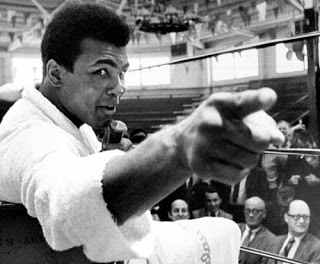
Flicking through Charles Hoff’s work, I remembered I had jotted down miscellaneous notes on the subject of Boxing, some years ago when I was intrigued by it’s history and by the nature of the fascination it held for me. One of the reasons I became interested in boxing was that it presents itself as a lineage, a tradition, and that this tradition has it’s own ‘reading list’, the library of fight movies that are available from collectors. Times, places, protagonists, all captured on film, and part of a chronological order. I could set this reading list of fighters alongside and in parallel to the list of great 20th century poets. Both provide windows onto their times, particular points of entry into the strangeness of history. I had also been reading about the practical application of Zen to various arts, and was being made aware of the fact that there are many different kinds of intelligence, not simply the literary and philosophical, or mathematical and scientific. Takuan Soho [1573-1645] is particularly instructive on the application of Zen to fight strategy, the integration of bodily knowledge to the point where it’s execution is unselfconscious, where mind is no longer hindered and does not ‘stop’ anywhere, but responds instantly and appropriately to each situation. It seemed to me that the best boxers embodied principles similar to this. I’ve posted some of my jottings below. Does anyone remember Naseem Hamed? I wrote these before Barrera defeated him. It turned out that loss in the ring was something he could not rebound from, unlike Ali.

Boxing Notes


Boxing is a language, a physical language. It appears as a glissando of violence, but it has a depth of inscape equal to that of birdsong. What we hear of birdsong is the surface elision, not the vertical structure that playback at slower speeds reveals. The photographs of Charles Hoff read boxing vertically, as a composition of discrete moments. We have difficulty reading boxing in real times because of the sovereignty of it’s own means of expression, and the sheer speed of it’s utterance.

Boxing is primarily about biography, character, what it is that shapes a man, ands his training, his forging himself into an instrument.

Much of a boxer’s training and preparation has to do with an inward psychological bolstering against anticipated opponents. Note Ali’s love of the mirror. Joe Frazier shadow boxing: fractional movements, completed inwardly. A form of mental visualisation and interior rehearsal,. Joe Frazier: burrows forward under the surface of an opponents defence, like a mole, or man in the trenches. He undermines the walls of his opponents defense. Joe Louis: stalks his opponent, his cautious and remorselessly incremental crabwise approach.

Boxers invest so heavily in their self belief, and encourage others to do so, that when they say ‘I cannot be beaten’, they mean it, as an abbreviated form of ‘I cannot afford to be beaten’. This applies with particular relevance to Hamed. How will he react to his inevitable first defeat?

Naseem Hamed: ‘ticks over’as a way of maintaining reaction times, his entry to music and constant bravado, wiggling and posturing are a way of keeping the gap between will and act, conception and execution, closed.

For the boxer, reflexive analyses constitutes a hiatus.

Boxers must eliminate the gap between will and act, conception and execution. To do this, they first of all invest in their physicality through an act of will so that the body obeys the will. But what they are attempting to attain is a point in this process of investment at which the body repays with a surfeit of energy and response, when it blossoms with an embodied inspiration.

Boxers then think in the body, and reflexive analyses is replaced by interpretative action.

This constitutes the formalisation of instinct, it’s gardening, and is part of the grace of violence which is the attraction of boxing: the way training and discipline elevate a man above raw instinct in just a situation in which raw instinct is at it’s most insistent.

Raw instinct, untrained, is a weakness in a fighter. And there is a way in which each fight can be interpreted as a process of sounding out between opponents of each others’ depth of training. A fighter will attempt to elicit and map involuntary reactions in his opponent, in order to exploit these. He will attempt to attack up to, and past, the limits of his opponents defense, and then augment his attack manoeuvres with additional moves, in response to the blindspots and weaknesses thus revealed. The better a boxer is, the more disciplined, the more difficult it is for his opponent to force him to reveal his involuntary reactions, his raw, untrained instincts.

The space between two fighters…What is going on in that space? Ali: constant motion, circling his opponent. This charges the space between him and his opponent with a field of potential angles. As he moves, he is mapping these, examining their viability.

A ‘tight’ boxer, such as Ernie Terrel, or the Welsh boxer Steve Robinson from whom Naseem Hamed won the WBO title, operates wit thin a narrow cone of potential angles. When confronted with Hamed, Robinson was unable to focus him within the diameter of this cone. In addition, Hamed’s 360 degrees field of attack meant that Robinson was alternately blind to his approaches, or had his attention dispersed beyond the mechanics of his own counterattack. He couldn’t see to hit him, and when he could see him, he couldn’t hit him.

Muhammed Ali boxed on a bow wave of constant surprise, buoyed up and carried forward by a physical intelligence more spontaneous than incremental problem solving, which is a slave to terms dictated.

In the opening rounds a man is bright with fear. He is made of breath, a pulse, and powerful elastics. He bounces from foot to foot in a small, severe kingdom of vertical light, where details are registered with a micro-chisel and time has a paved, expansive feel to it.

He sharpens to acuity in his Cerebellum, reaches crisis by a process of radical deletion. He has his spine, and it’s pathways.

He faces a man as instrumental as himself. Who will try to beat him into pieces of thinking. The segments breaking off will destabilise his poise, and begin to wobble him toward total disintegration.

To avoid this, he periodically tests his body in the free spaces available to it, dipping, bobbing, dancing, healing it’s integrity between flurries of blows, or by armouring his advance, detaching himself from peripheral pain as if it were a bombardment on the distant horizon.

As the rounds advance, weariness begins to deposit it’s minerals.

His shoulder sockets begin to manifest themselves as iron, as do his ribs. The arch of each eye socket begins to heat into prominence, and a hot, ragged tar rises up in his lungs. He is lathed in veneers of sweat. Now the man is wearing a coat of meat, heavy, and the cables at the back of his heels are beginning to whine in distress. His consciousness begins to fog up like a bar room mirror.

Boxing is a form of self knowledge, a physical examination of conscience. Floyd Patterson knew this. Hence his provisional manner, the hesitancy of his character outside the ring, and the monastic, contemplative fervour of his training.

A man only knows himself in extremis, when he pushes, or is pushed, past his armchair conceptions of himself, to how he is revealed in the last analyses of his acts. The thing itself. Bathed in a Sui Generis light.

Each fight is an X-ray.

Each fight is a densely worded text, like a page of runes. It invites and resists decipherment. It attracts and appals, like barbarian metalwork, embryonic, animalmorphic, bubbling with chimeras struggling to get loose, and recycled under in the thrash of muscle.

A great fight demands total self-absorption in it’s riddle, and a solution to a problem with the same magnitude as life and death. The magnitudes are equal because the fighter has sacrificed everything to the riddle. He has invested his total psychic energy in it, it encapsulates his value system, is the absolute yardstick by which he will be judged. Everything else outside the ring floats free in a zero gravity, until that time the riddle is solved, temporarily.

Posted in Uncategorized | Leave a Comment »

Charles Hoff

Posted by Eckhart's Dog Woof! Woof! on November 21, 2009

Charles Hoff

Bumbling around the Internet today I came across a link that mentioned Charles Hoff, and Sotheby’s. It turns out that Sotheby’s are auctioning some 70 vintage boxing prints from the archive of the New York Daily News. Charles Hoff was a sports photographer with the paper during the 30’s, 40’s and 50’s. He is the only photographer who’s work I am at all familiar with. His black and white photographs of boxers are things of sudden beauty. They reveal the depth of compressed inscape below a surface elision of violence and excitement. In boxing, every instant counts, because at any instant a failure to attend fully can have devastating consequences. It is this depth of concentration, and of the reach of consequence, that these photographs capture. There is a book of Hoff’s boxing photographs available: The Fights, With a forward by Richard Ford and an accompanying essay by A.J. Liebling, amongst others. Liebling is another one who’s work I would never have encountered except through my interest in boxing. He is a tremendous writer who treats boxing not simply as a sport, but as a subculture. I always feel I am in excellent company when I read him. His books include The Sweet Science, and A Neutral Corner, both collections of his journalistic pieces. There is also another book of his called Back where I Came From, which is less concerned with boxing and ranges more widely over his own life. Pop over to http://www.dailynewspix.com/ and have a look at Hoff’s photographs, then decide if you want to hunt down a copy of The Fights.

Posted in Uncategorized | Leave a Comment »

Celan, A Possible Reading

Posted by Eckhart's Dog Woof! Woof! on November 21, 2009

Celan: a possible reading.

Celan is one of those poets I have an ongoing engagement with, based on a faith that there is an extraordinary depth of meaning there to be discovered. Not, of course, that once discovered you could ever paraphrase such meaning in terms other than as it manifests itself in the poems themselves. Almost unlike any other poet, you cannot even begin to describe a Celan poem. You must simply go there, and read, re-read, listen, and wait. However, that’s not prevented me jotting this: Celan- not ‘meaning’, but object, as a crafted piece of crystal has viability, refracting images. This would account for the metaphors involving crystals in his poems. The poem not as a conveyance of meaning, but a refraction, a reorganisation, of the word and world.: a word-world, a third space equidistant between the two, where word and world are intimately enmeshed as light and image in a crystal. Keeping this space open was his best option for continuing to use German, on terms more his own.
.
.
All those sleep shapes, crystalline,
that you assumed
in the language shadow,
.
to those
I lead my blood
.
.
The translation is Michael Hamburger’s, which suddenly reveals to me the debt I owe to his work: my faith that Paul Celan repays continued reading is mediated by the faith I have in Hamburger’s translations, most of which I have thoroughly internalised. In fact, I clearly associate his translations with a particular time and place: Belfast, Walnut street, off Donegall pass, 1989, Winter into Spring.

Posted in Uncategorized | Leave a Comment »

Cato of Utica

Posted by Eckhart's Dog Woof! Woof! on November 21, 2009

Cato of Utica

I’m a big fan of Dante. To the modern day poet, accustomed to the open-ended and provisional in both form and content, his powers of systematic exposition and integration are…humbling. Mind you, he had certain advantages: his universe was finite, heierarchical, and comprehensively mapped out by Scholastic Theology, especially by that of St Thomas Aquinas. I take holidays in Dante, extended periods of reading that are like visiting a foreign country [I also take yearly a holiday to Moby Dick, but that’s for another post]. Once, while unemployed and living in Belfast, and during a particularly intense period of reading the Divine Comedy, I dreamed that I was led backwards through the Inferno, in fast reverse, and abandoned in the limbo that is the antechamber to Hell. The limbo, that is, for the indecisive. I wrote about it, as below:

Canto III

The damned are not those shades embedded within the stratified torments of Hell itself, but those excluded from it’s schema:

The indecisive disintegrating into prose.

I had, I know, intended to say something about the sea, about how the moon and the sea, their anxious metals tangling, achieve
A glorification

But it was a deux ex machina of the language that did not, for some reason, sound justified.

A diferent metaphor could have been found to describe that sudden escalation of brightness.

Some other poet, not me, could have been walking the shore of Belfast Lough when the cloud cover parted.


But that’s an aside. What I want to write about is the figure of Cato of Utica, who appears in Canto 1 of Purgatory, as something of an allegorical figure. What is done to him is troubling: a loss, a small erasing of love which I find difficult to accept. A tiny part of Cato has been blanked out, lobotimised.

“Marcia”, said he, “when I lived over there,
So pleased the eyes of me, that whatsoever
She asked me, that I did, and did not spare.

Now that she dwells beyond the evil river
She may not move me, by the edict made
When I was taken thence – not now, nor ever.

He remembers, but is anaethetised to his former feelings. Cato at the foot of Mount Purgatory is no less excluded and tortureless than Cato in the first circle of Hell, he is no closer to admittance to God, never will be admitted to God, and, worse, is rendered companionless and emptied to a degree of his former personality. He is depersonalised by the machinary of Allegory. It might have been my mental state at the time, but his inability even to feel loneliness, when he had been so thoroughly robbed, left unable to emotionally register his loss, prompted me to dissent. Whoa……! Craig Coyle dissents from Dante! Pass the Lithium.

1.

He spoke, and then hesitated, as if
something about what he had just said troubled him…

I sneaked a quick drag on my spliff,
coughed, and looked round at the other two, Slim

Shady and his idealistic sidekick,
Amazingly neither of whom

seemed moved to interject.
So I voiced an inquiry and dogma of my own.

Is it right of God to alter or to reject
the loves of a creature simply to fulfill a function?

Rather be damned and retain love
than, what, brought to the slopes of purgation,

anaethetised, and left unsaved?……!!

2.

If a creature sins finitely, within the span of it’s lifetime and the limited scope of it’s powers
Why is it damned for eternity?

He constructed an experiment: an act,
And it’s lightbulb.

Then flicked the switch and marvelled at the shadows: dendrites magnified big as spidercrabs!
Infitesimal maneouvres, absurd:

Archimedes, knitting with stilts,
Or the planetary regress of small acts of kindness.

He who lives by the Aubergine dies by the sword…..

Will Cato of Utica be returned
To the First Circle on the Final Day,

His love restored?

Posted in Uncategorized | Leave a Comment »

The Prose Poem

Posted by Eckhart's Dog Woof! Woof! on November 21, 2009

The Prose Poem

I enjoy writing in formal patterns, for the sheer fun of it. It’s like constructing an Airfix model, the poem as gadget, or puzzle. Having a form to work with or against gives you a grid reference that locates you within a tradition. The Sonnet, Terza Rima, a chain of Couplets or Quatrains, Blank Verse, all have their rules, and customs, predecessors and inherited expectations. Right away you have something you can play with, a technical thing you can tinker with and treat as a formal exercise in the absence of any genuine inspiration. And sometimes, what starts as a formal exercise, accretes meaning until it reaches a critical density where a real poem gets switched on, and the thing becomes energised. All of this by way of introduction to the sequence of poems below, which are prose poems. They gave me tremendous difficulties, precisely because of their lack of objective structure. When there are no restraints on how a thing can be said, how do you say it? Anyone who has made a sustained attempt at writing, be it poetry or fiction, will have experienced that bewildered paralyses that can grip you when faced with the infinite array of things that can be said and the infinite ways in which it can be articulated. Commit yourself to even half a line, and your loss in terms of the unsaid is consequently infinite. It’d better be a damn good half-line, in fact, it would need to be the One True and Radiant Line. Form is Justification. It is a simplistic quip, but it has a psychological truth. It is easier to feel you are making the correct choices when writing a Sonnet, than when battling against the sense of psychic dispersal that is the consequence of too much freedom. Prose is so much more difficult to navigate across. The sequence below was intended to be a big hefty piece of prose, with huge paragraphs moving forward with cumulative weight. Like 19th Century prose. However, as I wrote, I got lost, so I rewrote, chipping away, making the prose more jagged, trying to get it to follow more precisely the contours of something I hoped was underlying, something it could adhere to. The process became lapidary, and the result something of a prose mosaic.
 

101 Ella Street

1.

A resonant wooden staircase. Woodgrain polished by footsoles, iron nail heads, wrinkled drippings of yellow paint;

Dust in the corners: mineral grit from burst insulation, crumbled plaster;

Dead woodlice.

Then the attic itself, it’s floor at eye-level broad as a ship’s deck.

It amplifies the sound of his footsteps as he walks across to where a mirror stands propped against a pile of old suitcases.

Once again he conducts the enigmatic experiment of simply looking into the mirror for a long, long time,

Saying his name,

Trying to grasp the co-ordinates of his birth.

2.

My earliest memory is unearthly, composed of dust, white noise, and voices of congratulation: the grainy, televised images and the radio communications of the Apollo Moon Mission.
I can recall only the descent, the lunar module settling into it’s own disturbance like an awkward crustacean.
I was sitting in a chair beside the window, which overlooked the garden. My mother knelt beside the chair and pointed through the window to the actual moon. It hung directly above the shaggy, dark mass of our weeping willow, which gathered and loosened, in the long, slow pulses of the wind.
Can you see them? She asked.
I tried, but could see no sign of the landing craft, which had loomed, magnified, in our television.

3.

A street in Hanoi, the day after the Tet Offensive.
A man who has his hands tied behind his back is being shoved along stumbling by a South Vietnamese General.
They are accompanied by a crowd, and a camera crew.
They stop.
The General steps forward. With the tip of a pistol he places a small hole, instantly ringed with a scorch mark, in one side of the man’s head.
The General steps back.
The executed man is dead on his feet. Blood issues in long, collapsing loops from the bullet wound in his temple, and he reacts with mouth-movements to the disruption taking place behind his eyes, which remain open.
He has become a strange kind of fish.
Then his nervous system shuts down, and the body falls forward onto it’s face.

4.

We lived at 101 Ella Street, Bloomfield, New Jersey. Our house, two stories overlooking a ground level garage, sat back from the street. Twenty or so concrete steps led up to it’s front porch. You entered through a screen door of fine wire mesh, then through another door of frosted glass patterned with clear flowers.
Inside, the porch resembled a ship’s bridge stripped of it’s instrumentation, or the whitewashed, timber wheelhouse of a boat.
The surf of distant traffic would linger in it’s wall cavities, like the distant decay of rain.
In the intermissions, the sound of your own breathing, close, and the detailed sounds of your own wet mouth.
In the early evenings of summer my mother would sit out here and paint, or, with all the big windows swung open, speak with Anna, creaking back and forth on her rocking chair on the porch next door.

Blue space, friendly, over the roof tops.
The talk is of local things, close to hand: Anna admiring one of my mother’s roses, and saying so.

Yes.
It was bright yellow fringed with red, and the wasps it attracted had black backs, golden ribs, and strange, magnetic flight paths.

They were the things themselves.
I should have studied them for what they were.

5.

Memory is at it’s most involuntary during sickness; membranes weaken and let through, partitions grow translucent.
Sickbeds are linked across time by abreaction.
The tinkling of a wind-chime, heard through an open window, welds two autumn nights, decades apart, together into one…
When sick, I always remember my original bedroom at 101 Ella Street: a Mickey Mouse alarm clock ticking on the bedside table, a Vicks Vap-O-Rub machine wheezing friendly, medicinal clouds of steam.
Whatever I wanted I could have. New books, new toys.
I suffered badly and often from bronchitis as a child; it felt as if stalactites were forming and bristling in my lungs. Only concentrated, shallow breathing, as if I were a sheet of water in a pan, avoided the hurt.
I lay in bed and heard the day outside roll onwards, with it’s gear-changes, breezes, heel-taps and Bluejays impinging through glass.
On the wall opposite my bed stood my desk and bookcase. Certain valued items were arranged neatly on the desk: a large, plastic bodied microscope, a small metal one, a small safe with genuine combination lock, two walkie-talkies, and my fossil collection, a boxed set bought from the New York Museum of Natural History.
If I remember correctly, this collection consisted of:
– a shark’s tooth, black and stony at the root, it’s cutting surfaces a pale grey lined with darker, mineralised cracks;
– a limestone Brachiopod;
– a solid cluster of octagonal or hexagonal plant stems, snapped and revealing a cross-section;
– the ghost of a fish;
– an unassuming spiral shell, of sedimentary rock.
The rest, ironically, I forget, but in addition I had a number of large slates. When split apart along their layers these revealed fern imprints of such photographic detail that even the most delicate veins could be seen.

6.

What I really want to talk about is the Firefly.
And the Praying Mantis.
To my mind, neither of these are merely insects. They are significations.
The Firefly is indicative of that which lies beyond words, and which you can barely catch. The instant you arrive it is gone, and all you are left with is a trace of light behind the eyes, the scent of the cherry tree under which you are standing, and the wild exuberance of subsequent hermeneutics.
Night after night under the electric desk-lamp, joyful and grateful neverthless.
The Praying Mantis is a Zen Koan, a serrated paradox, a mystic with a knife. It is a 14th Century depiction of Death, scythe cradled in it’s arms, standing enveloped in a Nirvana hush.
And it’s mind is a drop of clear, poisonous liquid.
It marries and deanimates the word, rendering it a headless, mechanical stalk powered by ideational reflexes.
I knew of a man in Bloomfield who kept a pet Praying Mantis leashed at the neck by a small collar and fine silver chain to his bottom bedpost, where it would perch at night.
I thought he must be very strange to want to sleep under the gaze of that predator.
At the foot of my bed had always been stationed the Angel Gabriel himself, to guard against nightmares and monsters and a water stain on the ceiling, which had the profile of a giant, and whose pounding footsteps were my frightened heartbeats.
But things get complicated, and we can’t always select our muse.

7.

There is the idea of the thing, and speculation concerning the thing.
Then there is the thing itself.
If I fully attend to the thing itself, until my whole head disappears and I become simple and clear as a lense, will I be able to speak?
Without falsifying?
But if I attend one micron above the plane of focus, then language shimmers and plays in the interval.
As if, at best, it were a field or halo generated by the thing itself.
Like a Paramecium, brightly lit from below, hunting silently behind a slip cover…

Shout as loud as you can.
They won’t hear you.

Because language no longer concurs with you: it’s propulsions are suddenly so different.

It goes off, on it’s own.

When it comes back, it never really does.

‘Goodnight’ and ‘I love you’ never again sound the way they used to.

8.

Infinitesimal, glinting metals on the rim of comprehension; sleep-grains of the Sandman; boulders of dust dislodged under the bed by the monster’s careful breathing; moon-minerals, resettling; nights that I lay awake straining to hear the message until my whole body became an

[ear]

a booming listening!
Signals from beyond the farthest sills, the windows’ and the horizons’

And the night-awareness of a child.

9.

My parents bedroom. The room you were not allowed in.

But only this room had air-conditioning.

The entire bottom half of one window was taken up by a machine. With an other-worldly whoosh this machine would create fresh, dry air in the midst of even the muggiest summer’s day.

It marked the division between time and eternity, between hot play, activity and blur, and rest, reflection and taxonomy.

I would sit in front of it’s metal grill, ands peer into it’s workings where I could see ice precipitate out of the day.

It was a domestic model of the quantum void, a Valhalla for dead flies.

Beyond the rotating veil of it’s fan you could see the street, micro-sectioned into harder, fiercer outlines as if by a strobelight.

The Zachino’s Pontiac, our oak tree, Kathy Abar riding past on her Schwinn bicycle with it’s yellow, wire frame basket.

And once, on 11 July 1968, a hurrying man from Western Union.

So, yes: as to the destinies of flies, men, and virtual particles, even from this perspective they are impossible to predict, and brief.

10.

Berkeley Elementary, my school, was at the top of Ella Street but on the other side of Main Street. You crossed over each morning under the watchful eyes of a warden.
It was a large, redbrick building with a white wooden belltower, but they never rang the old iron bell. Instead, pupils were summoned to morning assembly by the panic of small electric bells fixed to the walls of the corridors. Each class would line up behind it’s teacher in the auditorium to pledge allegiance o the flag, which was trooped onto the stage along with the school flag. Then the national anthem would be sung, after which each class would go to it’s room and there observe the one-minute silence.
I was an indifferent pupil, and remember nothing of the actual lessons. The only thing I do recall learning is how to tie my shoe laces.
Far more interesting to me were the Terrapins and the Angelfish we kept as class pets.
The Terrapins had chiselled, geometric heads and precision engineered shells. I took delight in examining just how well made they were, noting in particular the integrity of the seams bonding the shell plates together.
The architectonics of this creature cried out to be handled, held in the palm of the hand like an organic fob-watch.
The element of puzzle involved in their construction, in the configuration of shell plates on the carapace, hinted at a meeting, and seemed to encode a grammar the rules of which were hidden within or behind the creature itself.
In nature, or in God.
It doesn’t make sense, to an eight year old, that a thing might not have a meaning. It is self-evident to a child that there are languages other than those of man. Matter, as Bishop Berkeley wrote, is one of the languages of God.
An explanation never really fits. How many times have you heard a child say ‘yes, but…’ after an explanation has been given to him or her concerning something?
An explanation always leaves behind the thing it purports to explain, it never takes the thing with it.
The child’s attention stays with the thing, hence the “yes, but..”
Each thing is its own idiolect, lucid and replete in itself and in the comprehension of God, but an enigma to us, whose language reflexes are exclusive.
We are in a certain sense illiterate because of our languages.

11.

Jewelled and weightless, mouthing prayers composed solely of the purest vowels, the angelfish swam in a world weirdly distorted and crowded with eyes, as if the aquarium were the throne room of Revelations IV.
It was life with an artificial hue, tinted with eschatological metals.
The mind ached trying to take it in.
Tiny adhesive snails travelled on the walls of the tank, scouring the glass for algae. Air, expansive and invisible in our world, rose silver and discrete in theirs, globular, shivering and wobbling the fronds.
Lesser fish, colourless as if embryonic, darted avoiding the angelfish. On bright days the thread lines of their guts could be seen, and the granular darkness of their hearts.
One Monday morning we arrived to find the bitten, ragged carcass of one of the angelfish floating upside down in the tank. It was white-eyed, and seeped an oily residue, which spread as a film on the water’s surface.
The angelfish, it turned out, were killers. They were cannibals.
We stood round the aquarium and starred at those breathing fissures of light with a fresh sense of horror.
Which is, after all, a kind of renewal.

12.

One of my favourite activities at school, during the free time, when there were no lessons being taught and we were left to our own devices, was the plotting out of mazes on 5 millimetre graph paper.
I had a rival and partner in this, a girl whose name I no longer remember but who sat across the table from me in the library. We would exchange and try out on each other examples of our work.
I wanted to design a maze that was successively stunning in its cruel and florid ramifications, one that would leave the seeker stumbling like a tranced calf along glittering corridors where torches cast a pantomime and dripping water is amplified and scary…
Certain rules were applied to achieve this result:

1. As many paths as possible should terminate as near as possible to the Central Chamber. Dead-ends should ideally be separated from the Central Chamber by the thickness of a mere pen-stroke, or be situated in the Central Chamber’s immediate vicinity. Failure should be acute, on the verge of success: the realisation that you must have committed a wrong choice at some stage during the journey should occur in the final instant, after the delusive belief that the goal is about to be attained.
2. Mistakes made upon entering the maze should have effects that snowball: a law of inverse proportion should be one of the principles governing the maze’s structure, and the One True Path grow remote and subliminal as a molecular chain, a thread of DNA.
3. There should be multiple entrances.
4. There should be no One True Path.
5. Instead, there should be a multiplicity of false paths. When edited and travelled upon in correct combinative order, these will in retrospect constitute the One True Path.
6. The Central Chamber should not be located at the centre.
Anywhere but, in fact.

I wish I’d kept these mazes, they constituted a proto-poetic oeuvre I have not equalled since.

13.

But then it was August, with its leafsmell and its blood cherries, and its constellations in league with the quietude of the maple; and I was running, through the gardens: Graziano’s, the Zachino’s, the Abar’s because it was evening and everything was an occurrence, a simple exposure to cooling sky.
Awareness, spacious, it’s twin co-ordinates the pulse of blood at my temple and the intermittant signals of a
firefly,
there orbiting under the eaves of the maple, it’s chemico-mystical intestines fuelled by the darkness that every child wonders at: the darkness before his birth; the darkness behind his Now: and the darkness out of which his thinking about darkness emerges as he spins round to catch himself on the brink of…

14.

I wanted to become a palaeontologist, and dig dinosaur bones in Arizona. Because I had rights which were being ignored, and I would never get to see a live Triceratops.

Or a Struthiomimius of the Late Cretaceous period, an elegant bird-like dinosaur that once inhabited the grassy plains of central North America.

And which evolved and vanished like a biological tornado millions of years before I was born.

But who was to blame? No-one. Just a law of mutability operant in every detail, jiggling grains of sand, photographing victims in slate and in limestone, rotting our dog back into earth under our weeping willow.

Sometimes, as when lying awake in bed on a hot June night after a thunderstorm had refreshed the atmosphere and constellations sparkled

The silence of things gone would infiltrate the trees,

Or cluster round the chime of a metal gate, and linger in the footsteps of someone walking alone down Ella Street.

So I conceived of a heaven that was open and democratic: every species would be there, any creature that had ever succumbed wholly to the past tense.

From Samantha, our dog, to the Struthiominmus of the Late Cretaceous period.

And all would have the power of speech.

I even imagined how we would enter this kingdom. First a lightbulb, just one, would expire with a glassy ping, the after image of it’s internal wiring like the snapshot of an insect.

And then another one close by.

And then another.

Until a rustling as of locusts incrementally deleted the New York suburbs, and swept inwards

And even the billboards in Times Square began to shower.

Then silence, as the last querulous hoot of a car horn faded.

Exposure.

As if the soul were a ceramic thing, the ground of life a cold stone floor.

Objects would start exploding into dense, molecular clouds of primary colours, the way television screens might explode in a Walt Disney carton: millions of little dots, liberated, mixing in slow motion.

The laws of fluid mechanics would briefly hold, then give way under pressure from the miraculous as forms began to cohere and glow.

And the first man to step forth, studying his hands in wonder, would be Hugh Coyle, who I last saw lying in a glossy dark wood box in a funeral parlour in downtown Bloomfield.

Then others: men, women, children, rubbing their eyes, laughing;

Bluejays, fireflies, terrapins, with their chiselled geometric heads and precision engineered shells, salamanders, with their highly reactive skins still sizzling;

Hallucagenia, Opabinia, Struthiomimus,

And our dog, Samantha;

Each achieving gem-like resolution, as if the principle of individuation had taken on a microscopic focus:

The soundless division of bacterium like the parting of continents;

Triceratops,

Huge and pristine, and detailed as the tiniest steel green beetle compact and aglow in a crevice of bark on the trunk of a reconstructed oak.

Posted in Uncategorized | Leave a Comment »