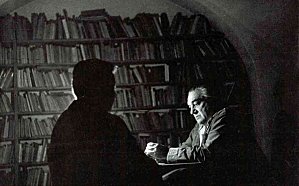
Vladimir Holan. Holan is a Czech poet. I first came across his work in a box of books in a house on the shores of Belfast Lough. The house was owned by one of my English Lecturers. She had moved out, and myself and a few other students rented rooms. The box, a treasure trove, contained works by most of the major East European poets of the 20th Century. Many of them signed by their authors. I toyed with the idea of diverting some of these into my posession, but couldn’t convince myself that it would be somehow ok to do so. Geekily, I remember each book vividly. In fact, I remember more of them than I do of the degree I was supposed to be studying for. Holan was in there. Selections from ‘A Night With Hamlet’, his most famous long poem, and many of his shorter poems, for which he is best known. I know little about his personal life: he was a Catholic, left the church. joined the Communist Party, left the Communist Party, and rejoined the Church. A classic pattern. In his later years he lived in the centre of Prague, as a recluse. I don’t know enough about Czech literature to contextualise him within his native tradition. But he certainly appears to be different from other European poets of his generation. His shorter pieces engage in a kind of sorting, a zoom-lense attempt to discriminate amongst phenomena in order to uncover and frame the undefinable. When his shorter pieces are successful, he reveals something that you know cannot be made visible in any other way.
(Between)
Archive for the ‘Poetry Anthology’ Category
Poetry Anthology
Between, Vladimir Holan
Posted by Eckhart's Dog Woof! Woof! on February 19, 2010
Posted in Poetry Anthology | Leave a Comment »
To Robinson Jeffares, Ceslaw Milosz
Posted by Eckhart's Dog Woof! Woof! on February 19, 2010

Czeslaw Milosz is the greatest of the 20th Century Polish poets. Some regard him as the greatest 20th century poet, full stop. His greatness may not be immediately obvious, especially to those of us reliant on translations, though he has been well served in his translators, most of whom are poets of some substance themselves. At first reading, Milosz’s merits were not to me obvious, as I was in thrall to the subjective pyrotechnics of Plath and the punchy, close-up maneouverings of Robert Lowell. But I persisted. Something in me felt challenged by Milosz. He did not compose within a subjective, amoral bubble. He didn’t excuse himself or claim exemption from ordinary human obligations, including moral obligations, on artistic grounds. There’s nothing in Milosz that would appeal to a teenager, for example. When I started to commit to reading his body of work with a view to grasping it, it was a commitment to grow up. Milosz is a total subscriber to what he calls ‘the human experiment’, he doesn’t live in geological time, or pinpoint his co-ordinates within biology, he works from within human history, cultural-time, and refuses to relinquish ground to those who feel superior to others by virtue of their nihilistic viewpoint, a stepping outwith the human. His poetry is a constant search for meaning, and it encompasses the entirety of human civilisation. His mind is first class. He would have made a great philosopher. Or a great economist. Or historian, statesman, or even scientist. But he chose poetry, or, as he says, poetry chose him. And as fate would have it, he was set down on earth at the perfect point in place and time to record the course of the entire 20th Century, to bear witness to its most gigantic insanities: Facism, and so-called Communism. He hoped for ‘a day of comprehension’, an ultimate unveiling when the entire spectacle would at last make sense. A hope that has an eschatological dimension, but also a practical one: because he tried to realise it within his own limited lifetime and and as far as his limited powers would allow. It’s difficult to know what to select from his works, his poems are mostly large and ‘tend towards the condition of prose’, because he did not want to be exclusive. Otherwise, how could he ever hope to comprehend? I’ve chosen a poem from his previously unpublished works, witheld out of kindness, I think. It is a rebuke. It may be addressed to Robinson Jeffares, but at the time I read it, I took it personally.
(To Robinson Jeffares)
Posted in Poetry Anthology | Leave a Comment »
Poem 129, Osip Mandelstam
Posted by Eckhart's Dog Woof! Woof! on February 19, 2010
Mandelstam. Osip Emilievich Mandelstam was one of the great Russian poets of the early 20th Century. He stands alongside Boris Pasternak, Anna Akhmatova, and Marina Tsetayava, as part of that group of poets whose work responded to the Stalinist terror. There’s a famous story told about Mandelstam that reflects just how highly regarded poetry was in Russia during this time. Mandelstam had written a poem, ‘The Kremlin Mountaineer’, in which he calls Stalin a ‘Peasant Slayer’. He read this aloud at a literary gathering, popular in those days amongst the intelligentsia. Someone reported back to Stalin, and Mandelstam predictably was arrested. He was held in the infamous Lubiyanka, headquarters of the secret police, where he was intensively interrogated. It is said that Mandelstam was actually brought before Stalin himself to answer questions. In addition, while he was still in prison, Stalin phoned Pasternak to ask: is he, Mandelstam, a good poet? Stalin’s respect for poetry was such that Mandelstam was not killed, but released into internal exile, an ‘inner emigre’. He settled in Voronezh, a village outside Moscow, and there composed what have come to be known as the poems from the Voronezh Notebook. From this point onwards he experienced symptoms of mental illness. He lived in a state of nervous anxiety punctuated by bouts of paranoia, with at least one well attested suicide attempt. He must have known that the respect Stalin held towards poetry and poets would only preserve him for so long, that, sooner or later, his henchmen would return to finish the job. The most sensible thing would be to shut up, but Mandelstam suffered from what he called in one poem ‘nightingale fever’: an inability to stop singing. Furthermore, his poems of this time show a strong faith in the everyday and domestic, an awareness of the beauty of being at home in the world that is not diminished by the threat of mortality. He believed that poetry had a truth-telling function, and he accepted the fate that such an obligation entailed in times like his. The poem below reflects this. Written after the revolution had already turned sour, and after the first flush of his own literary fame, and youth, has passed, he predicts the inevitable, but eschews lamentation and tears.
Poem 129 (as numbered in the Collected Works)
Posted in Poetry Anthology | Leave a Comment »
Fable, Janos Pilinsky
Posted by Eckhart's Dog Woof! Woof! on February 19, 2010

Fable
Janos Pilinsky was a Hungarian poet. Born in Budapest in 1921, he was conscripted into the army during World War 2, and spent the last year of the war in various prison camps in Germany and Austria. This experience was definitive. A Catholic, a committed Catholic, what he experienced during the war and in these camps was something he subsequently wrestled with for the rest of his life. He could have chosen the easy route, become an atheist and walk away from his former commitments. But he didn’t, he stayed, and worked the emptiness, year after year. I’m not convinced he believed in a God, His existence, in any simple fashion, but I think he did not believe in his absence. When he confronted the emptiness, it was as a religious poet who never flinched from the biological evidence. The Incarnation and Redemptive Suffering would have been default templates to use to help make sense of the horror, yet he avoids both. How is it then that his poems can appear so luminous? Over and over again he returns to the scene of the crime, examines the evidence, and then examines it, examines it, and examines it…until it begins to shine, like a chalice, like a monstrance. But as the ‘fable’ below demonstrates, not everything that shines let’s you in.
(Fable)
Posted in Poetry Anthology | Leave a Comment »
To The Heart, Tadeusz Rozewicz
Posted by Eckhart's Dog Woof! Woof! on February 19, 2010

Tadeusz Rozewicz is of that generation of Polish poets who wrote their best work in the aftermath of World War 2, others of whom I’ll get round to mentioning. I like this poem because it echoes findings on the practicalities of evil that were published by Jay Lifton in his study of evil called The Nazi Doctors. The question Lifton addressed was, why and how did medical doctors take part in the Final Solution in the numbers they did? One of his conclusions was that they did so by constructing what he called an Auschwitz Self that treated morality as context dependant, relative, and that prioritised technical expertise above moral judgement. In this sense, a ‘good’ doctor was one who implemented the Final Solution with efficiency. Rosewicz predates Lifton’s work, but this poem zeroes in on that psychological state that allows a man to perform evil whilst still still laying claim to prestige. But just because a man is good at doing something doesn’t mean he is a good man, nor does a narrow focus on technicalities excuse one from wider moral responsibilities. The title is ironic, and not.
(To The Heart)
Posted in Poetry Anthology | Leave a Comment »
Anthology
Posted by Eckhart's Dog Woof! Woof! on February 19, 2010
I’m in the process of compiling an anthology of poems, essentially to give to my children as an introduction to poetry, and through poetry to wider concerns in philosophy, history, theology, science, etc. A lot of my own education is anchored by poetry. You start with a poem, or a poet’s body of work, and travel outwards in expanding rings of interpretation. It’s a good way to learn, and helps maintain focus. For copyright reasons, however, I cannot always post the particular poem that I would like to append to each ‘blurb’. So I’ll just name it. If you’re interested, you can go look it up.
Plath:

Poppies in October
Plath is a cult figure. She was married to Ted Hughes, who she met at Cambridge University. They married in 1956, and seperated in 1962. Plath committed suicide in 1963. She had suffered from depressive episodes most of her adult life. Her one novel, The Bell Jar, is a record of an earlier suicide attempt, and of her subsequent treatment, that pre-dated her Fullbright Scholarship to Cambridge. A lot of her later poems are records of extreme states of mind, and one or two raise moral and aesthetic issues in their choice of subject matter. She rather infamously made reference to the Holocaust, or Shoah, in a reverse-telescope sort of way: not to contextualise her own suffering or to treat of the Holocaust from a wider cultural and historical perspective, but as metaphor and imagery for her own subjective states. This has led Seamus Heaney, for example, to assess her as a definitive poet, but not a great one. She was certainly a poetic genius, her use of language is driven by a sense of rythmn that generates chains of metaphor and imagery and allusion, a spectacle that unfolds in front of you without hidden, background preparation. In that way she is a naked writer. Very quickly on reading her work, you sense it’s origin, usually in a psychic disturbance. The distance it travels from conception in the poet’s mind to completion and autonomy on the page is very short, so you gain a sense of incipience and unfolding which is very infectious, and which leaves you with the sensation that you know her privately, which is one of the reasons, no doubt,for her achieving cult status. I read her very closely for a few years. I think of her as sort of a distant Aunt. Poppies in October records the kind of surprise that many of her poems must have induced within herself, when they arrived so sudden, as given.
(Poppies in October)
Posted in Poetry Anthology | Leave a Comment »
A Slumber did my spirit seal…
Posted by Eckhart's Dog Woof! Woof! on February 8, 2010
Pome of the day. The poem below is by William Wordsworth. I’m not a big fan. He is often categorised as a Nature Poet and Romantic. However, compared to Ted Hughes and DH Lawrence, for example, he tends to describe nature in the abstract, and under philosophical headings. This poem is one of his smaller pieces, and though we do not know who She was, the poem is insistant on emphasising the fact that she has ceased to be. What is significant is the vocabulary he uses: Motion, Force. These are terms taken from Physics. The Romantic movement was in some respects a reaction to the rise of science and it’s triumphant consolidation into a theory unifying the mundane and the celestial, the Newtonian synthesis. No matter how much he may laud his own sensibilities and muse on the mystical face of Nature, somewhere in the recesses of his mind must have lurked a fear, born of the implications of the success of science: it’s obliterating impersonality that cared not a fig for his delicate imaginings. In this little poem he tests himself, his nerve: for eight lines he peeks at the machine as it processes a figure of romantic longing into an object with the same status as ‘rocks, and stones, and trees’. The implication by the end is that the machine just keeps going….
A slumber did my spirit seal;
I had no human fears:
She seemed a thing that could not feel
The touch of earthly years.
No motion has she now, no force;
She neither hears nor sees;
Rolled round in earth’s diurnal course,
With rocks, and stone, and trees.
Posted in Poetry Anthology | Leave a Comment »
 FruitFly